A2.5


WWW
-
Your idea was highly original and distinctive, making the pitch stand out effectively.
-
The inclusion of emotional marketing added depth and made the concept more engaging.
-
It was excellent to see the recipe and ingredients included early in the pitch.
-
The visual presentation was strong, with impressive posters, merchandise, and overall design work.
-
Your use of a 90s/2000s nostalgic style was particularly effective and well suited to the concept.
-
The structure of dividing the instructional video into four sections was a thoughtful and organised approach.
-
The inclusion of the food, branding, and pricing considerations made the project feel relevant and well developed.
-
The mood board, vision, and supporting website were clear, creative, and professional.
EBI
-
You could provide a clearer explanation of the narrative structure and overall plan for the video.
-
It would be beneficial to include more detail about your technical skills and production choices.
-
You should explain how cinematography, editing, camera work, audio, and any special techniques will support the final product.
-
It would strengthen the pitch to show more clearly how your research has informed your ideas.
-
You could also explain how the nostalgic style will be represented through conventions, music, and visual features.
Final video pitch

Feedback i recieved that were summarized by AI:


Production Proposal


Completed final cut
Production log

-
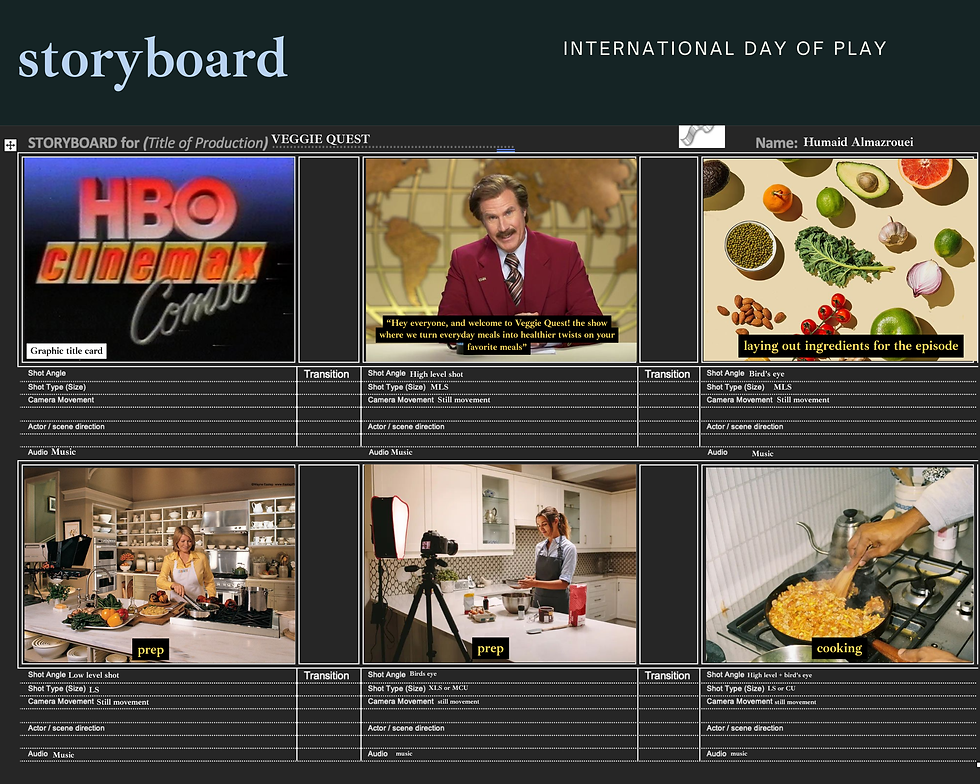
GRAPHIC TITLE CARD
-
2nd close up host shot, High level shot, MLS size, still movement
-
3rd overhead shot, MLS, Birds' eye level angle, still movement
-
4th prep shot, Low level shot, LS size, still movement
-
5th prep shot, Birds eye, either MLS or MCU, still movement
-
6th cooking shot, High level or birds eye, LS or CU, still movement
-
AD
-
AD
-
3rd Back on air shot, MLS, Eye level angle, still movement
-
4th overhead cooking shot, Birds eye level, MLS size, still movement
-
5th cooking shot, Eye level, High stop, still movement
-
6th cooking shot, High level or birds eye, MLS or MCU, still movement
Reflection
My initial intentions for this campaign were that I wanted to create a fun health-based cooking show for Veggie Quest in an engaging / nostalgic way that was emulating the 90s/00s. At the start, the idea was more general and concept-based, and as the project developed, it became a more focused, scripted cooking show. I chose to do this because it represents the way I approach my work and how i naturally develop many of my ideas on my own. The final cut changed drastically from my initial intention because of how much more nuance it developed after my feedback. I felt like I went blindly; I didn’t expect to go through a lot of problems (because of the conflict in the middle east) during the process and so i wasn’t able to think clearly with the distractions and tried my hardest to still do my best with what I had to work with. I had to change what i did because even if I was kind of satisfied with the recording + editing there were still LOTS of moments postproduction where I wasn’t up to the level I wanted yet and it felt like it was instead me being sleep deprived that convinced myself that what I had done was THE final product and that’s something I am trying to work on as well. But overall, I am happy with what I produced. All the instructional videos i did helped me with my final cut because i made sure that my research (primary and secondary) was cohesive because i had a clear vision from the start and knew what to search for and find. I am a very big archival person and i love deep diving, so this helped me a lot for my final cut. When it came to my script, this was the first time I wrote a 7-page script, and I also used my script as an indicator / compass to help me further. It was useful during editing and post-production because it gave me a clear structure to follow and helped my imagination so I could picture how I wanted it. When it came to the visual part, my storyboard was a major factor in developing the script because it changed the idea from being something written into something i could visualize physically on screen. It helped me think about how the scenes would look, and how the camera would capture each moment. When it came to my location recce, i explored different possible places to film and initially considered using a peer’s house. However, after asking around i realized that using someone’s house would have been difficult to organize so i settled filming at school. The school location worked well in the end and for my final cut because it suited the project better than I expected it to, and so it made filming easier to manage. For my risk assessment, i looked at what could go wrong during filming and checked if anything could cause harm to the crew, i thought about possible dangers like heat, sharp knives and made sure everything was controlled and safe even with the lighting and camera. This helped me understand that safety is an important part of production and made sure i could film without any accidents. When it came to my work ethic, I did try my best to complete tasks on time but there were a lot of factors that didn’t allow me to and that was cause i faced some delays due to the conflict in the middle east and because of this, we had to go online and leave school frequently which made it hard to track progress and stay consistent. This affected my timeline and made it harder to maintain a steady workflow but i still made a lot of improvements throughout the process. I tried many ways of working, saw what suited me best, and adapted that to keep moving forward and I'm proud of how i managed to push through the challenges and still create something meaningful. Looking ahead i think i can improve my work ethic by focusing less on motivation and more on discipline, since motivation can come and go but discipline really does help me stay consistent when things are difficult. The feedback i received along the way and after the first cut helped me a lot because it gave me a clearer idea of what to improve and where to focus my efforts. The feedback i was given was to strengthen veggie quest branding which made me add a logo or watermark + a 90s-style banner during email submission segments, which made the show feel even more authentic. The feedback helped me understand how to make the final advert more polished, more on brand and more effective at delivering the campaign's message. Yes i do think my final cut/ brief fits the purpose because it successfully promotes healthier alternatives / plant-based eating as an affordable alternative to meat, which is exactly what the veggie quest brief asked for. The narrative focuses on a meat-free nacho recipe that directly swaps beef for alternative ingredients, showing the viewers a more practical and realistic way to reduce meat consumption. The sound includes original music i created + copyright music (although i do have scenes where people are talking in the background, i didn't have much time to prepare for a microphone which is something i would like to work on for next project) Which adds a strong 90s aesthetic and makes the show feel like a mini movie. I used a lot of VHS-style effects and vintage transitions to reinforce my initial idea. The Mise-En-Scene included the school kitchen setting, warm lighting and the retro style graphics + title cards. For my cinematography I used a lot of close-ups of the ingredients, overhead cooking shows, MAINLY medium shots of the hosts as they talk and i just really wanted a clear tutorial. I feel like my video clearly communicated the message i wanted it to because of how i positioned the characters and narrative. Especially because i made it very clear that i wanted this to be a 90s nostalgic video and so i really did try my hardest when it came to the technical bits because it takes a lot to change a modern video to look like a video from the 90s with the plugins (signal) color grading & subtitles as well. + graphics that I externally had to find + pay for because they were that specific. The cinematography for me was the easy part because i included medium and close up shots of what was going on in the kitchen and luckily the way i had written the script i didn’t really even want to do lots of stuff with the cinematography in the first place because my technical skills were truly the essential part of my video and what made it shine even further. I think my instructional video is appropriate because it's catered around all ages no matter what the target audience is. However, i feel like it might not be suitable for viewers who aren’t paying attention to understand what’s happening or for those who prefer a different style of instructional videos. But that’s actually the point of what i was trying to create, a video that everyone of all ages can enjoy. Something I'll do different next time is to go deeper and try to make it more relatable and appropriate for an even wider range of viewers, since some people might find the music or script not quite to their taste, which is completely understandable. The techniques I used in my instructional video were informative, nostalgia, and humor. I utilized these techniques through technical parts and theory parts as well. And they were effective because these are like the foundational basis of every single video. I feel like my instructional video was effective because of the characters and narrative. I really tried to make the video meaningful and layered for viewers who understand the intended message while also keeping it simple and easy to follow for those who are new to this type of content. My video was technically effective because i tried new things that i have not done before when it came to editing it and recording it post-script and post-production. With regards to my cinematography and sound and editing I really did try my hardest and went out of my shell when it came to it. The feedback that i got from my final instructional video was self-feedback + from peers and audience members. I do agree with my feedback because i always feel like it's important to see a POV that's different from yours and how you can make it as digestible and appeal further to MORE audience members. Overall, i am very happy with my instructional video for Veggie Quest. Producing it taught me invaluable lessons that i will carry on forward. One of the main things i learnt is the importance of not rushing myself, especially when working with cinematography and other technical elements. Patience kind of became essential because i had to take time by framing the angles carefully, adjusting the lighting, and refining each detail. And because of that, it made a real difference in the quality of my final piece. This was my first time creating something like this, and i truly pushed myself to stand out. If i hadn’t tried my hardest i wouldn’t have reached the level I'm at now and through this process i discovered that showing up fully and giving it my best even when things felt uncertain at the time is what allowed the growth to happen especially during these things. One thing I'll carry into my next production is the ability to go with the flow and recognize how meaningful it is that im creating, building and following my dreams in a way even when the outcome doesn't match the high expectations i had set for myself. Even though, I knew it would still somehow work. Rather than shutting down or avoiding the discomfort, I chose to rather self-reflect and learn from it and move forward with more clarity in the best way possible. I realized that it wasn't about perfection but mostly about the consistency and the reflection to keep myself creating and avoiding any form of burnout or self-doubts NO MATTER WHAT. Veggie quest was truly a memorable one and i am very happy with what i have done in this campaign.
